
AI Assistant in Revit (Preview): AI Support for More Efficient Design
Across nearly every industry, the way people work with AI is fundamentally changing. Users are moving from completing individual tasks to setting higher-level goals…
Across nearly every industry, the way people work with artificial intelligence is undergoing a fundamental change. Users are shifting from executing tasks directly to setting higher-level objectives and making decisions. Instead of controlling every command manually, they define intentions, constraints, and desired outcomes. This means they no longer have to focus on how a task gets done and can concentrate on what they need to achieve.
For the AEC industry, this shift creates significant opportunities. It helps teams increase productivity, think at a larger scale, and advance the industry. Autodesk is bringing this approach directly into users' everyday workflows.
Autodesk Assistant
Autodesk Assistant is an AI interface for Design & Make workflows. Whether users need quick answers, analysis of their work, or faster routine operations, Assistant helps them work more efficiently while preserving the creative side of design.
This marks the next major step in Autodesk's AI development: a generative AI conversational interface that works directly within the tools professionals use every day. Embedding AI into workflows helps remove unnecessary steps, simplify labor-intensive tasks, and support faster, better-informed decisions. Assistant can serve as an accessible entry point to AI, expanding design capabilities without changing the way people think about their work.
Autodesk Assistant in Revit — Available in Tech Preview
Autodesk Assistant in Revit is now available as a Tech Preview. AI is built directly into the design environment users work in daily, providing early access to a growing and evolving set of supported workflows.
Autodesk Assistant offers a new conversational way to interact with Revit. Rather than searching through menus or documentation, users can:
- ask questions about Revit features;
- analyze and explore a model;
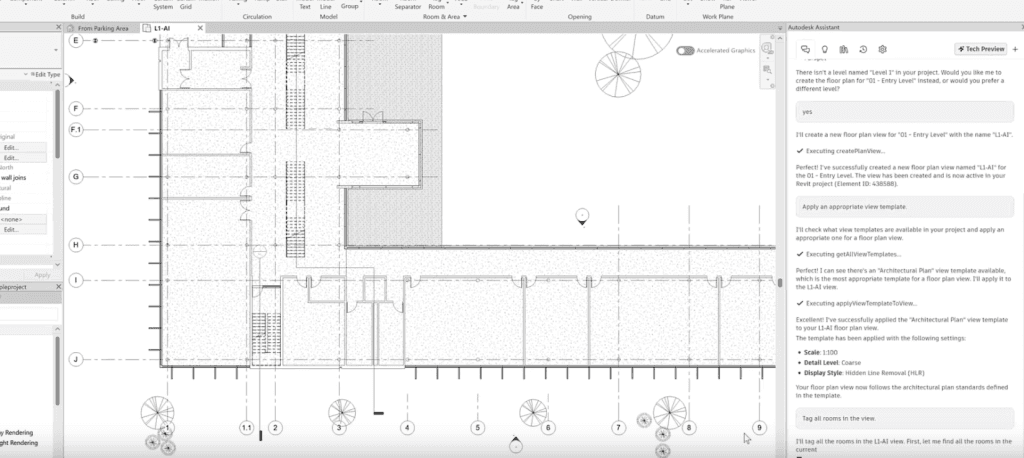
- perform actions using natural-language prompts, such as "Create a door schedule sorted by level" or "Create a floor plan for level L1 and name it L1-AI";
- receive personalized recommendations, such as guidance on the new Numbering tool, based on their actions while preparing documentation.
All of this is available through a simple chat interface built directly into Revit.
Instant Help from Trusted Sources
Autodesk Assistant provides contextual answers based on official Autodesk documentation, helping users quickly understand tools and workflows without leaving Revit. Whether they are learning a new feature or refreshing their knowledge, Assistant helps them continue working without unnecessary interruptions.
For example, a user can ask, "Show me how to set up sheets and views," and receive clear step-by-step instructions, best-practice recommendations, and links to original sources.
Model Analysis and Understanding
Users can ask Autodesk Assistant questions about the current model, project, or design solution and receive answers when they need them.
Instead of searching for or counting elements manually, Assistant can do this work. It analyzes the model and responds in context, allowing users to focus on design.
Example prompts:
- "How many structural columns have Base Level set to L2?"
- "Count all door and window tags in view L2."
- "Check whether a view template is assigned to every view on sheets A100–A106."
Turn Intent into Action
Autodesk Assistant goes beyond answering questions to turn intentions into real actions.
From modifying model elements to producing documentation, Assistant helps transform a request into a specific result.
In the example shown, an AI-driven workflow automatically creates a floor plan for level 2, applies the appropriate view template, and places room tags. This configuration is then used to automatically produce similar plans for levels 3 and 4, followed by sheet creation, naming, layout, and export to PDF.
Learn and Improve Efficiency with Insights
Autodesk Assistant does more than answer questions: it helps users continuously improve their workflows.
With My Insights, users receive personalized recommendations based on their working context, including:
- keyboard shortcuts that speed up repetitive, time-consuming operations;
- features the user might not know about;
- best practices based on the workflows in use.
These recommendations are generated dynamically from actual product usage, helping users build more efficient habits, discover new capabilities, and increase productivity over time.
Grounded in Real Workflows Through MCP
Autodesk Assistant uses Model Context Protocol (MCP), enabling more reliable, contextual, and actionable answers.
With MCP, Autodesk Assistant can better understand a model's structure and support real workflows, including:
- Model Query — analyzing and exploring a Revit model;
- Export — generating project documentation and deliverables;
- Sheet Management & Documentation — organizing sheets and project documentation;
- Room Management — planning and coordinating spaces;
- Schedules & Data Management — managing project data and creating reports;
- Element Operations & Manipulation — directly managing and modifying model elements.
Together, these capabilities allow Autodesk Assistant to go beyond a conventional question-and-answer tool and become a comprehensive assistant in the design process.
Trust Principles in Autodesk Assistant
Autodesk follows principles of responsible, ethical, and secure AI development, deployment, and use.
The company applies strict data governance procedures and a Privacy by Design approach to protect customer data and intellectual property. Data use is limited to stated purposes and controlled sharing methods.
Autodesk Assistant uses:
- User conversation — questions asked during the current session;
- Autodesk documentation — official help materials at help.autodesk.com;
- User work data — in certain products, Assistant may use model or project context to answer questions.
The Prompt Library and Chat History are stored in the cloud and linked to the user's Autodesk account. These data, as well as any personal customer information, are not used to train large language models (LLMs).
Assistant can also connect to MCP servers to access additional tools and data sources. These servers are provided by Autodesk and operate in accordance with Autodesk security and privacy standards.
Looking Ahead
This is only the beginning. AI in Revit is not just designed to solve existing problems. It also creates new opportunities. The goal is not merely to remove obstacles but to deliver additional value. AI can expand what is possible in design and project delivery.
Autodesk aims to improve efficiency at every stage of design and engineering, placing greater emphasis on the complex creative work that delivers the most value to customers' projects.
As Autodesk Assistant evolves, the Autodesk team is focused on helping users spend more time on what matters most: producing better designs, working faster, and extending the boundaries of what is possible.
The current Autodesk Assistant for Revit Tech Preview is deliberately focused on a limited set of workflows rather than every task in Revit. This phase allows Autodesk to gather feedback, study real-world use, and continue improving the solution.
Autodesk invites users to join the community to explore available features, share feedback, and help shape the future of AI in Revit.