
Slope Stability Analysis: Simplicity Is the Key to Success
Geotechnical work in mining is varied and involves significant responsibility. At a client’s request, we helped address one of the most pressing issues: slope stability…
Contents
Geotechnical tasks in the mining industry are varied and carry major responsibility. At a client’s request, we helped address one of the most pressing issues: the stability of dam slopes at tailings storage facilities. Our analysis showed that the difficulties did not arise from a lack of professional expertise. The specialists had strong technical knowledge and experience.
The main challenge was the sheer volume of information and the complexity of geotechnical analysis. Choosing overly complicated software made matters worse: although the tools offered extensive capabilities, they proved inefficient for practical work.
Information Overload: A Threat to Stability
Geotechnical engineers process large amounts of data, including soil properties, groundwater levels, loads, and external conditions. All of these factors must be considered in calculations. At first, choosing the most advanced software with the broadest capabilities seems logical. In practice, however, such systems can be overloaded with functionality that gets in the engineer’s way.
Why Complex Software Is Not Always Effective
Complex systems can create additional challenges:
Many functions remain unused.
Specialists require extensive software training.
Calculations may demand a higher level of expertise.
Even experienced engineers may make mistakes when overwhelmed, reducing the reliability of results.
GEO5: A Simple Tool for Accurate Decisions
Against this background, GEO5 is a sensible choice. Its philosophy is simple: give engineers the tools they need without unnecessary complexity.
Just as a skilled worker with modern equipment still needs reliable basic tools such as a screwdriver and hard hat, geotechnical engineers need straightforward software. GEO5 modules are designed for this purpose.
Overview of GEO5 Modules for Slope Stability
Soil Slope Stability Analysis
The Slope Stability program provides analytical stability calculations for slopes formed by soils or weathered rock of known origin. It identifies the most critical circular or polygonal slip surface, evaluates different groundwater scenarios, and accounts for reinforcing elements such as ground anchors, soil nails, geosynthetics, and/or piles. Stabilizing piles can be checked for deformation and bearing capacity in the Stabilizing Pile program.
Rock Slope Stability
The Rock Stability program analyzes rock slopes sliding along planar or polygonal surfaces. It can also assess the stability of a rock wedge using Lambert stereographic projections.
Stability of Embankment Slopes
Slopes reinforced with geosynthetics can be designed in the Reinforced Earth program. In addition to stability analysis, it checks internal stability, sliding along reinforcement layers, overturning, sliding, and bearing capacity of the foundation soil.
The Soil Nailing program analyzes slopes reinforced with nails and shotcrete or steel mesh. In addition to checking overall stability, it can verify nail stability and determine the dimensions of reinforced concrete or steel mesh facing.
Finite Element Analysis
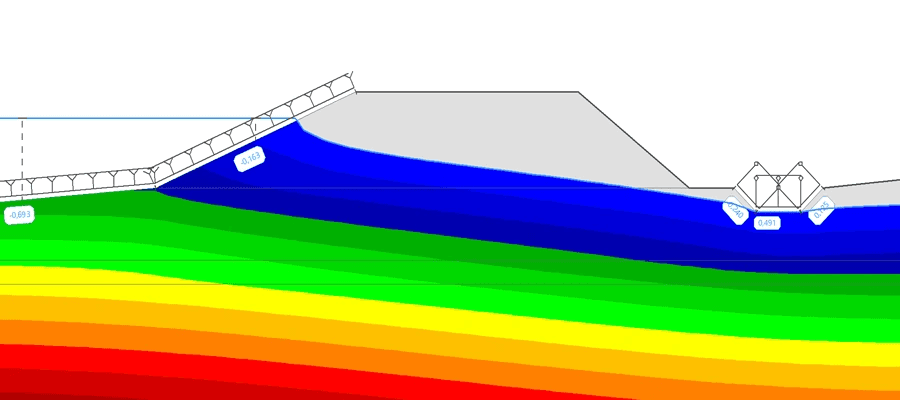
Groundwater can be assessed using the advanced Slope Stability – Water Flow module, which uses numerical modeling to analyze seepage and groundwater flow. Both steady-state and transient flow can be considered.
Overall slope stability can also be calculated with the FEM numerical modeling program. It uses gradual reduction of Mohr–Coulomb shear strength parameters (ϕ, c), which can be started at any construction stage. When numerical seepage analysis is needed, the additional FEM – Water Flow module can be used.
Practical Example
A mining client with slope stability problems was using complex software with extensive functionality. Its team found, however, that most features were not used and the complexity made the work harder.
After switching to GEO5, they:
Solved slope stability tasks with user-friendly modules.
Reduced calculation time thanks to the straightforward interface.
Saved money by eliminating unnecessary software.
The company concluded that GEO5 fully meets its current needs and plans to assess whether other software products are necessary, removing those that offer no significant benefits.
GEO5 simplicity is not a compromise; it is a close fit for real engineering tasks. It helps geotechnical engineers focus on what matters, work efficiently, and make reliable decisions.
Want to see how GEO5 could support your project? Contact us for a demonstration of the software suite tailored to your needs!