
From Heavy Machinery to a Legend: The Drafting Table Era
When we think of the 20th century, we picture not only industrial growth but also a defining symbol of that era: the drafting table. Large, adjustable, and fitted with precise rulers, it was…
When we think of the 20th century, we picture not only the scale of industry but also one of its defining tools: the drafting machine. Huge, adjustable, and equipped with extremely precise rulers, it was more than a tool. It was the center of engineering work, where bridges, machines, and entire cities took shape. Before CAD, the drafting table set both the pace and the culture of work in every design office.
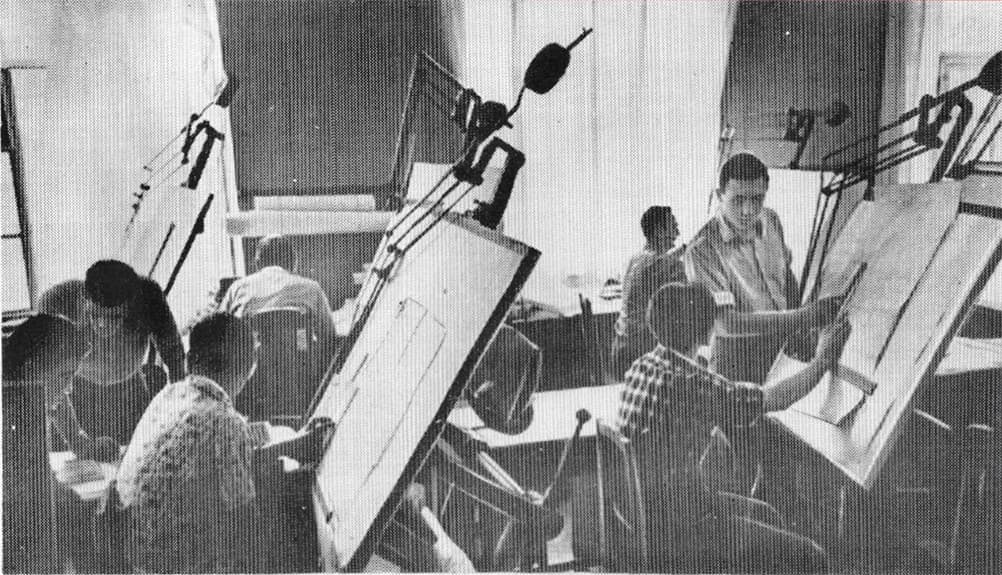
Interestingly, the Russian word "kulman" has two historical associations and became a generic name. One traces back to the German company Kuhlmann, a leader in precision drafting machines in the first half of the 20th century—much as brand names such as Xerox or Scotch tape became generic terms.
The other honors Carl Culmann, the founder of graphical statics, whose work shaped the engineering language used by generations of designers. The name thus carries respect for both precision engineering and foundational scientific principles.
In fact, the drafting machine was a precision mechanical device that could match the accuracy of electronic methods, a kind of analog computer. It consisted of a heavy frame, a board adjustable for tilt and height, and its key component: a highly accurate drafting head with two rulers fixed at 90 degrees, which could also be locked at other angles.
Complex mechanics, including a smooth-motion and braking system, ensured what CAD now provides: perfect parallels, precise angles, repeatable lines, and no distortion.
In the mid-20th century, while Germany's Kuhlmann set industry trends, the true workhorse of the Eastern Bloc was the Robotron Reiss drafting machine. Founded in 1882, Reiss became part of the legendary VEB Robotron industrial group in East Germany.
Robotron Reiss drafting machines quickly became a standard of industrial precision, known for their solid, durable construction and distinctive, restrained design. The A0-format Robotron Reiss Assistent S holds a special place in this history.
Designed for major projects in bridge building, mechanical engineering, and architecture, it featured a large working surface (approximately 150 by 90 cm), thoughtful ergonomics (including foot-controlled tilt in some configurations), and heavy, exceptionally durable metal mechanisms intended for decades of service.
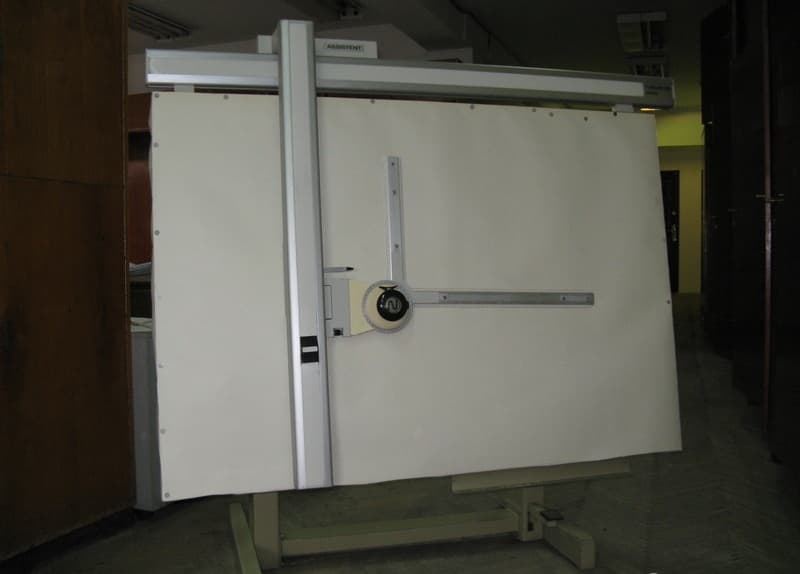
For hundreds of engineers, the Assistent S was more than a table. It was a work companion and a symbol of precision that defined engineering in East Germany and allied countries. As AutoCAD and other CAD systems became widespread, drafting machines gave way to monitors. But they never disappeared completely: their mechanics were too well engineered, and their industrial aesthetics too compelling.
Today, drafting machines are enjoying a second life as cultural objects. Enthusiasts restore them, artists and designers use them as striking pieces in loft interiors, and some still stretch drafting paper across them as in the past.
The drafting machine represents an engineering culture in which precision was achieved without electronics and reliability came from mechanics built to last. Legends such as the Robotron Reiss Assistent S will remain symbols of an era when engineers built the world not in pixels but with clean, confident lines on paper, where every millimeter mattered.