
Compression Curve or Constant Modulus: How the Way You Define Clay Stiffness Changes Settlement in GEO5
The same clay layer, the same 50 kPa load, yet the calculated settlement ranges from 2.8 to 10 mm. This is not an error. It comes down to how soil stiffness is defined in the analysis. Using a simple example, we look at how the different ways of specifying deformation parameters in GEO5 compare and when it makes sense to use oedometer test results.
Contents
Why a single modulus is not always enough
Clay does not compress uniformly: over some load ranges it is more compressible, over others it is stiffer. The oedometer test captures this directly. The sample is compressed with virtually no lateral expansion while the vertical effective stress is increased step by step, and the vertical strain is recorded at each step. The result is a compression curve showing how soil compressibility changes as the load grows [1, 2].
A constant modulus describes the soil with a single number across the entire stress range. It is convenient, but the non-linear behaviour of clay is lost. In GEO5 the oedometric modulus can be defined either way: as a constant value or through a σ′/ε curve. In the second case, the program selects the modulus for each layer according to its initial and final stress [1].
Input data for the example
Consider a clay foundation soil with the following properties: γ = 19.10 kN/m³; γsat = 19.50 kN/m³; ν = 0.42; Edef = 7.00 MPa. The surface load is q = 50 kPa.
To compare the ways of defining stiffness rather than the effect of foundation geometry, we look at a single homogeneous layer h = 1 m thick with an effective stress increment of Δσ′z = 50 kPa. In a real analysis GEO5 determines the stress increment with depth for each layer separately, and the surface pressure is not equal to the stress at depth [3]. This simplification is convenient for comparing methods, but the example does not give the total settlement of a specific structure.
The compression curve is defined by the points: 0 kPa — 0%; 50 kPa — 1.0%; 100 kPa — 1.5%; 200 kPa — 2.5%; 300 kPa — 4.0%. For each interval, the secant oedometric modulus is determined from the curve as the ratio of the stress increment to the strain increment [2]:
Eoed,i = (σ′₂ − σ′₁) / [ε(σ′₂) − ε(σ′₁)]
Table 1 — Oedometric modulus by stress interval
| Interval σ′, kPa | Δε, fraction | Eoed, MPa |
|---|---|---|
| 0–50 | 0.010 | 5.00 |
| 50–100 | 0.005 | 10.00 |
| 100–200 | 0.010 | 10.00 |
| 200–300 | 0.015 | 6.67 |
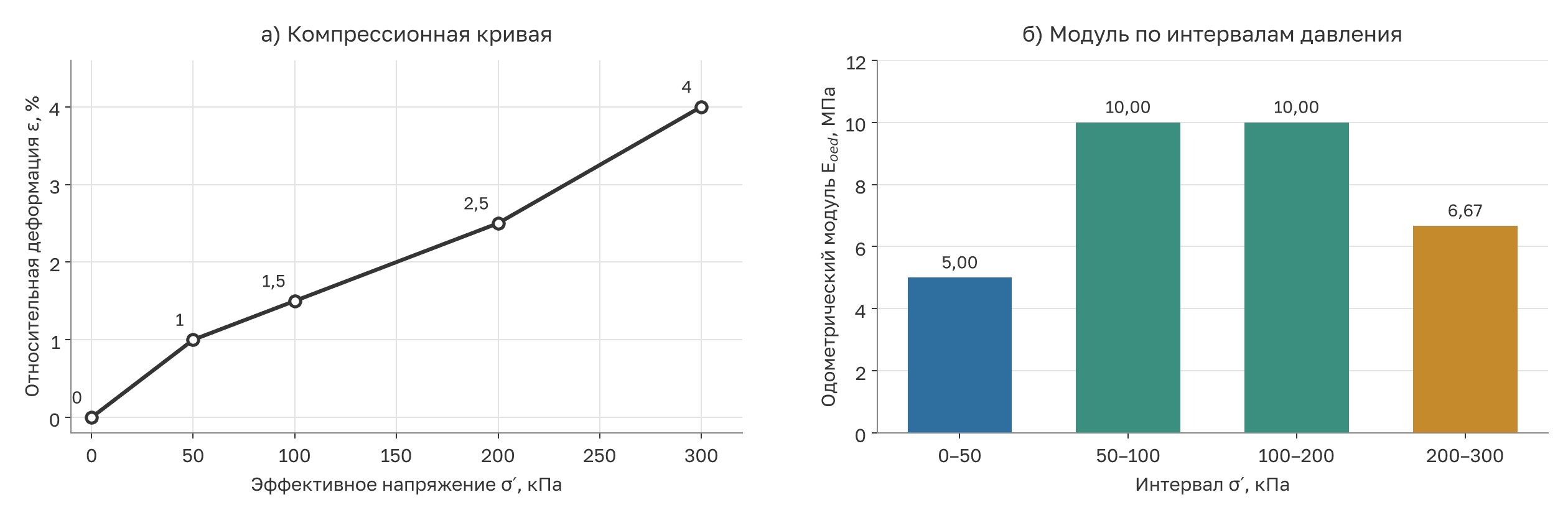
Figure 1 — a) compression curve ε(σ′); b) oedometric modulus Eoed for each stress interval
The table already shows that the modulus of the same soil varies by a factor of two: from 5 MPa in the first interval to 10 MPa in the second and third. Replacing the whole curve with a single number loses part of this information.
How layer settlement is calculated
The principle is the same for all methods: determine the initial stress in the layer, add the increment from the load, find the difference in strain and multiply it by the layer thickness.
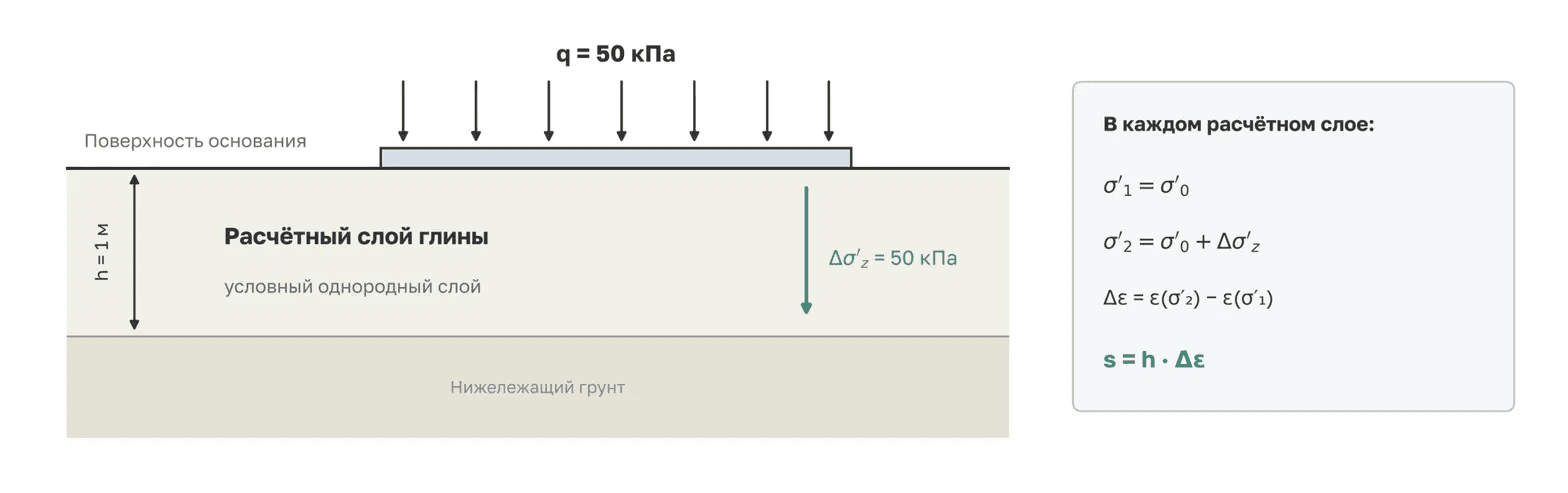
Figure 2 — Settlement calculation scheme for a notional clay layer under a 50 kPa load
The difference lies in where Δε comes from. Let us compare four options:
- Curve, initial stress 0. The layer works in the 0–50 kPa interval, where the soil is most compressible.
- Curve, initial stress 50 kPa. The same soil, but in the 50–100 kPa interval, where it is stiffer.
- Constant Eoed = 10 MPa. One value for the entire analysis.
- Deformation modulus Edef = 7 MPa. If the oedometric modulus is not available, GEO5 converts Edef using Poisson's ratio [1]: Eoed = Edef·(1 − ν) / [(1 + ν)(1 − 2ν)]. With ν = 0.42 this gives about 17.9 MPa.
Table 2 — Settlement of a 1 m thick layer at Δσ′z = 50 kPa
| Stiffness definition | Interval σ′, kPa | Settlement, mm |
|---|---|---|
| Curve ε(σ′), initial stress 0 | 0–50 | 10.00 |
| Curve ε(σ′), initial stress 50 kPa | 50–100 | 5.00 |
| Constant Eoed = 10 MPa | 50–100 | 5.00 |
| Edef = 7 MPa, ν = 0.42 | — | 2.80 |
The compression curve in the 50–100 kPa interval gives 78.7% more settlement than the calculation using Edef. In the 0–50 kPa interval the difference reaches 257%. The constant 10 MPa modulus matched the curve only because that is exactly the soil's modulus in the 50–100 kPa interval. In any other interval it would no longer match.
Why settlement depends on the initial stress
The most revealing picture appears when the initial stress in the layer is varied while the same 50 kPa load is applied.
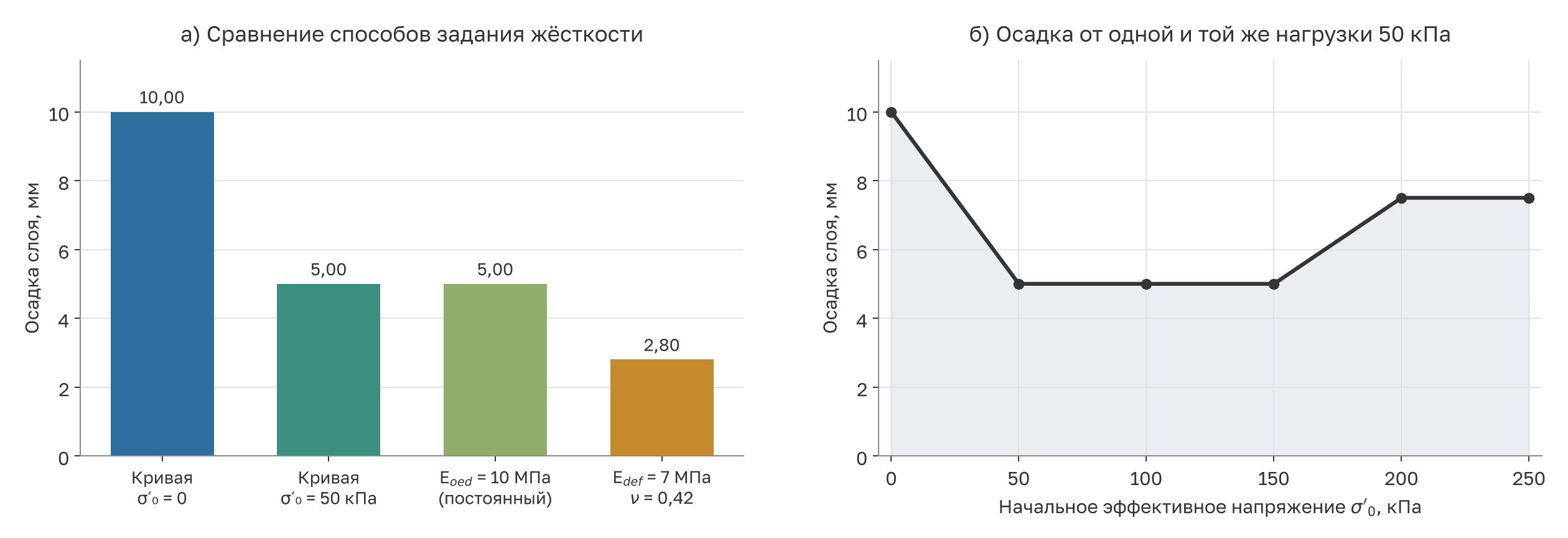
Figure 3 — a) layer settlement for different stiffness definitions; b) settlement under a 50 kPa load as a function of initial effective stress
Near the surface, where the initial stress is close to zero, the layer settles by 10 mm. At depths where it is 50–150 kPa, the same load gives only 5 mm, half as much. At an initial stress of 200 kPa, settlement rises again to 7.5 mm because the compression curve is steeper in the 200–300 kPa range. A constant modulus cannot show this: to it, every layer is equally stiff at any depth.
What this means in practice
In the example, the calculated settlement ranges from 2.80 to 10.00 mm purely because of how stiffness is defined and at what stress the layer works. A constant modulus does not always capture the non-linear compressibility of clay, especially when the foundation's zone of influence includes layers with very different initial stresses.
If oedometer test results are available, it is worth entering them into GEO5 as a curve rather than reducing them to a single modulus. The program will then account for which part of the curve each layer works on, and the settlement prediction will be closer to the actual behaviour of the foundation soil. Accuracy still depends on the quality of the input data: laboratory parameters must reflect the actual working conditions of the soil.
References
1. GEO5 Online Help. Analysis Using the Oedometric Modulus. finesoftware.eu
2. GEO5 Online Help. Oedometric Modulus. finesoftware.eu
3. GEO5 Online Help. Settlement Analysis. finesoftware.eu
4. Federal Highway Administration. Soils and Foundations Reference Manual. NHI-06-088. 2006.