
From Scan to CAD at Forma 3D: Reverse Engineering Discontinued Pump Impellers with Artec Leo
Based in Queensland, Australia, Condamine Drilling provides drilling, irrigation supply, and pump services across the region. Like many businesses in these industries, it relies on heavy-duty pump equipment that has been in service for years, sometimes decades. Over time, the original engineering drawings for some pump components were lost, and the manufacturers could no longer supply replacement parts.
Contents
The challenge
To create accurate CAD models of discontinued pump impellers with complex vane geometry and reflective surfaces that are difficult to capture.
The solution
Artec Leo, Artec Studio, SOLIDWORKS.
A watertight 3D mesh was created for each impeller, ready for CAD remodeling and subsequent bronze casting at a foundry. The replacement parts have already returned to service, and the client now has a digital asset to rely on whenever a failure occurs.
Why Artec 3D?
Artec Leo’s wireless, handheld design and real-time feedback make it possible to scan an object from every angle in a workshop and confirm full coverage before processing the data. Leo’s resolution, accuracy, and speed also make it ideal for fast-paced reverse engineering: the scanner can be used without repositioning the object or compromising precision.
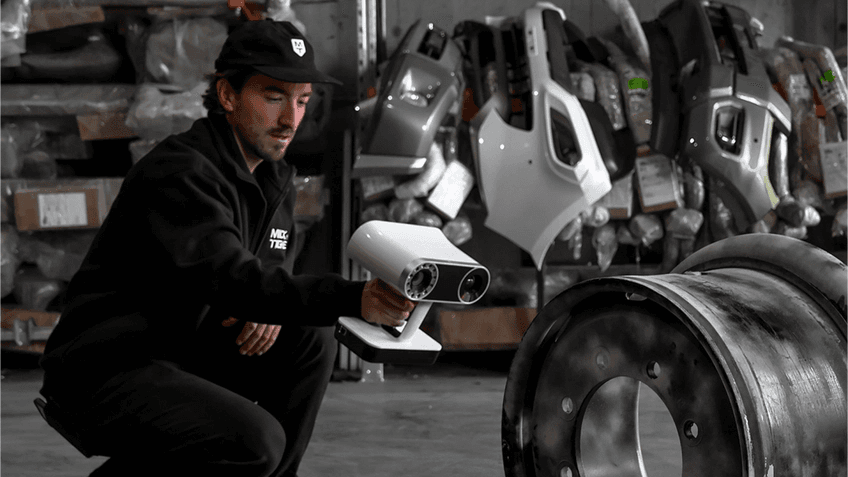
A Forma 3D technician digitizes an impeller with Artec Leo
Based in Queensland, Australia, Condamine Drilling provides drilling, irrigation supply, and pump services across the region. Like many businesses in these industries, it relies on heavy-duty pump equipment that has been in service for years, sometimes decades. Over time, the original engineering drawings for some pump components were lost, and the manufacturers could no longer supply replacement parts.
Looking for an alternative, Condamine contacted Forma 3D. The company provides 3D scanning services for the automotive, manufacturing, construction, and other industries. It uses Artec Leo, a powerful handheld 3D scanner supplied by Qubic, Artec’s Australian representative.
At first, the client wanted to find out whether the replacement parts could be 3D printed. However, 3D printing proved unsuitable because of the requirements for pressure resistance, fluid dynamics, and wear resistance. Forma 3D then proposed a different solution: creating CAD models that could be used to manufacture the parts with time-tested methods.
Reverse engineering with Artec Leo
Pump impellers often have complex geometry, including internal passages and curved vanes, which makes them difficult to digitize. Shiny surfaces can also pose a challenge for 3D scanners because they reflect laser light during capture. Manual modeling, meanwhile, remains slow and prone to errors. Since the internal vane profiles are critical to performance, Condamine needed a versatile, reliable solution.
That’s why the company chose Artec Leo, a wireless, self-contained 3D scanner that is ideal for working in small workshops without connecting to a laptop. The device provides real-time feedback, allowing users to check scan quality and coverage. This is especially valuable for reverse engineering, since gaps in complex geometry often become apparent only during data processing.
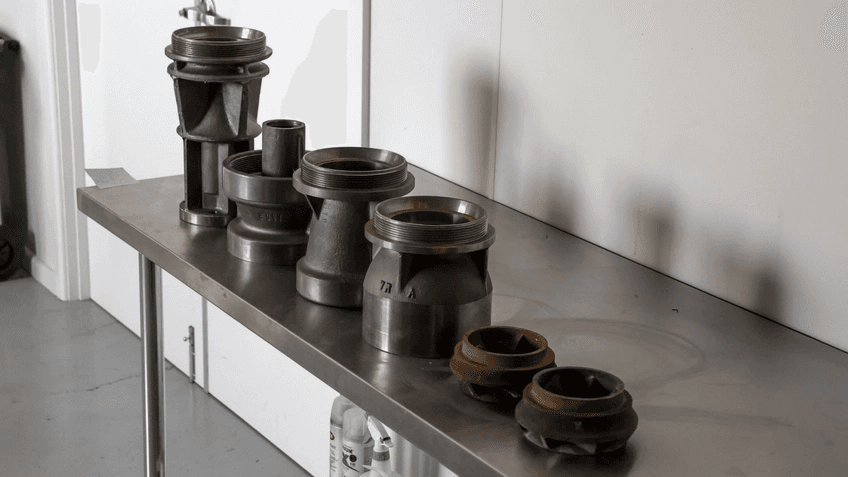
A range of impeller parts digitized by Forma 3D for Condamine Drilling
After receiving the project, Forma 3D technicians used Leo to scan several impellers. They would not have fit inside a desktop 3D scanner, but the wireless Leo could be easily moved around parts of different sizes. Speed was also important: capturing 35 million points per second, the scanner quickly handled all the parts without lengthy setup or calibration.
From 3D scanning to casting
After scanning, the data was processed in Artec Studio. The Global Registration function was used to accurately align all the frames into a single point cloud. The data was then combined into a highly detailed, watertight mesh using the Sharp Fusion algorithm. The digital model captured every surface of the impeller in such detail that it could be sent straight to SOLIDWORKS for redesign.
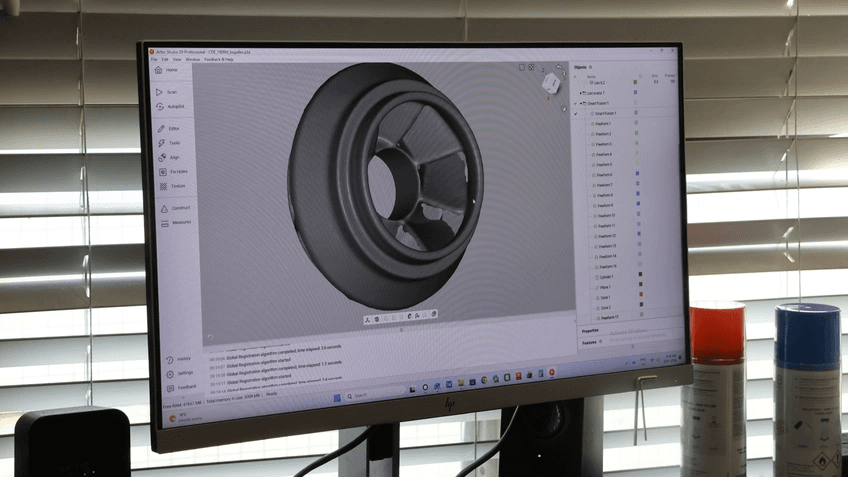
A scanned impeller part in Artec Studio
Condamine Drilling sent the finished designs directly to a foundry, where the impellers were cast in bronze. The raw castings were then machined and finished before being returned to service. Before contacting Forma 3D, Condamine had no practical way to replace broken parts that had been discontinued. Every conventional option had reached a dead end, making scanning followed by CAD modeling the only solution.
Ultimately, Artec 3D scanning transformed the process in terms of speed, accuracy, repeatability, and accessibility. The entire workflow now takes only a fraction of the time required for manual measurements and redrawing, while providing greater confidence in dimensional accuracy. Leo creates precise digital twins that can be sent to suppliers whenever replacement parts are needed.
A scalable solution for aging equipment
For Forma 3D, this project confirmed the effectiveness of its scan-to-CAD workflow in industrial settings and demonstrated its potential for a rapid return on investment. The finished 3D model can be sent directly to a supplier without engineering input. The process can be replicated across many other industries where replacement parts are no longer available.
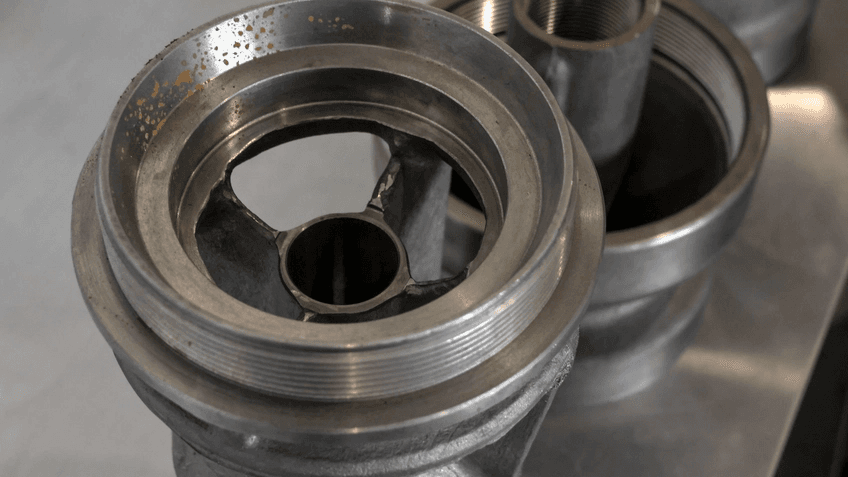
An example of the complex surfaces on Condamine’s impeller parts
Digital design was once available only to those with in-house engineering and manufacturing capabilities. Now, almost anyone can access 3D scanning and obtain reliable data for practical applications. Forma 3D sees significant potential for its services in mining, agriculture, water infrastructure, and heavy industry—in any project involving complex reverse engineering.
3D scanning is ideal for digitizing existing designs and building on them when original equipment supply chains have been disrupted, equipment has outlasted its documentation, or parts are no longer available. The technology can benefit anyone using legacy equipment. Condamine is just one of many companies to create a digital inventory of spare parts—and it won’t be the last.